The Immense Journey by Loren Eiseley
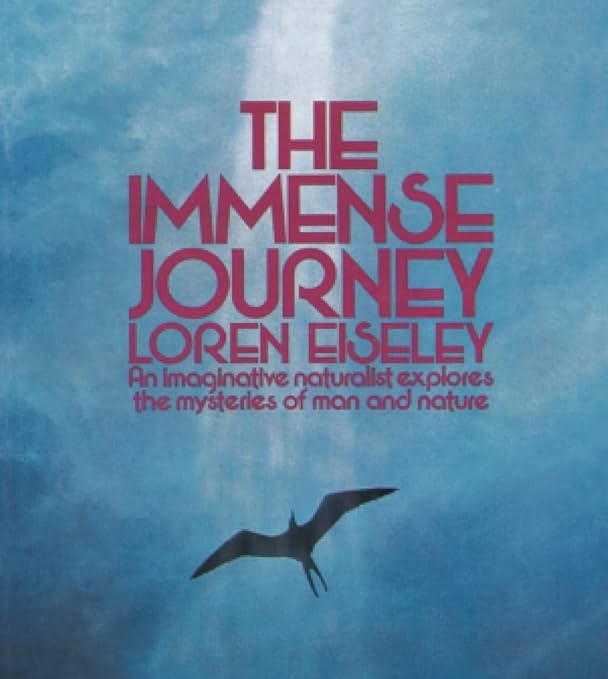
Loren Eiseley's The Immense Journey is a collection of personal naturalist story-essays from the 1940s and 1950s. It's hard to classify, but I would describe it as a highly imaginative intersection of natural history, poetic memoir, and evolutionary philosophy. I especially loved "The Slit", "The Flow of the River", "The Deeps", "How Flowers Changed the World", and "The Bird and the Machine". Best read in nature to match the slow and contemplative pace.
What follows is less of a review, and more of an excuse to pull on a few of the many compelling threads Eiseley weaves together throughout the book.
Understanding time through space
In "The Slit", as Eiseley climbs carefully down a slot canyon, his downward movement traces a journey back in time. This literary device reminded me of one of my favorite stories from Aldo Leopold called "Good Oak" where the author recalls a crew of lumberjacks felling a dead oak, and peeling back the layers of time as their saw cuts through each annual circle in the cross-section of the tree. As he does this, Leopold retells the history of his 80 acre Sand County farm from the oak's perspective.
Later, in "The Deeps", Eiseley follows Sir Charles Thompson on a virtual descent to the bottom of the ocean. Once again, going deeper corresponds to a move back in time:
To Sir Charles Thompson, however, the abyss was more than haunted. It was the world of the past.
Thompson was involved in the laying of the first transatlantic cable, and hoped to find an ancient world in the depths, but was ultimately disappointed.
I'm obsessed with time becoming space and I see it everywhere now. I'm not normally a Wagner fan; four hours is too long for an opera, and the associatiation with Nazis is a challenge, but I made an exception for Parsifal. In Wagner's mythic realm, Parsifal remarks that he feels he has barely walked, yet has traveled vast distances. You see, my son, here time becomes space:
Despite having conquered terrestrial space, we are fundamentally limited in time. We have our ~80 year lifespan to experience the world directly. Other than that, we can time travel only through geological strata and great books like these (see Temporal range hasn't expanded like spatial range). Eiseley describes it well:
We have joined the caravan, you might say, at a certain point. We will travel as far as we can, but we cannot in one lifetime see all that we would like to see and learn all that we would hunger to know.
Ancient sea within us
I read recently that the interior of a cell mirror the chemical environment of a carefully maintained Precambrian tide pool. Eiseley describes it more poetically:
All of the tremendous differences between living forms have been achieved only by the elaboration of devices for the maintenance of that inner nourishing liquidity in which cells can live and grow within a certain range, certain narrow range of tolerance. Not for nothing has the composition of mammalian blood led to our description as, 'walking sacks of seawater'. Not for nothing did the great French physiologist Bernard comment that, 'the stability of the interior environment is the condition of free life'
Time is not our only constraint, though. Most mammals must maintain their internal temperature at 36 - 40 °C. Stray away from that and you're dead.
Even in the realm of space, we exist within a highly fragile coordinate system. As you climb into the mountains, you end up in temperature extremes: too hot in the sun, too cold in the shade. As you descend into the ocean depths, the pressure becomes oppressive, it's too dark and damn cold.
Evolution without a plan
It's easy to think of ourselves as the pinnacle of some kind of divine plan.
Men have been men for so long that they tend not to question the fact. All their experience tells them that their children will precisely resemble themselves; that kittens will become cats and cats will have kittens, and that even caterpillars, though the pattern seems a little odd, will become butterflies, and butterflies will produce caterpillars. It is so habitual an event that we do not stop to ask why this happens...
This is true even for close observers of nature:
"Geology," said one writer, "un-rolls a prophetic scroll, in which the earlier animated creation points on to the later."
Louis Agassiz, a famous 19th century naturalist and part of the broader Agassiz family that founded the eponymous city in BC imagined the world as an implementation of greatness planned by a divine entity:
This plan of creation has not grown out of the necessary action of Physical laws, but was the free conception of the Almighty Intellect, matured in his thought before it was manifested in tangible external forms
But this is not how evolution works! We are very much just jumping from stepping stone to stepping stone. This is described well in "The Snout", describing the awkward desperate flailing of the mudskipper as it transitioned to land. It was not a smooth transition and we have no idea where things are going. Eiseley sees this clearly, again evoking the downward in space → backward in time idea.
I read a book in which a prominent scientist spoke cheerfully of some ten billion years of future time remaining to us. He pointed out happily the things that man might do throughout that period. Fish in the sea, I thought again, birds in the air. The climb all far behind us, the species fixed and sure.
Like the mudskipper, we are not immune from change. Eiseley thinks we are still in a "Ptolemaic" world view, despite the Copernican revolution. This rhymes a lot with Why Greatness Cannot Be Planned by Kenneth O. Stanley.
How Flowers Changed the World
Entangled Life by Merlin Sheldrake turned me on to the history of trees. Trees emerged in the Devonian period 350 million years ago, creating a huge stockpile of wood for the next 60 million years. Then fungi evolved to decompose wood, leaving a huge layer of tree mass in the layers of the earth (see Evolution of fungi and plants from 1500 ma to 290 ma)
In "How Flowers Changed the World", Eiseley opened my eyes to an even more pivotal role of flowers in the coevolution of mammals.
Flowers didn't exist until late dinosaur age. This is surprising, but at first I didn't get it: who cares about pretty petals and such? Here I found Eiseley's prose to be more poetic than explanatory, so I had to do a bit of external reading to piece things together.
Flowers aren't just pretty little things, but the reproductive organ of angiosperms. Angiosperms (literally "enclosed seeds") emerged around 130 Ma during the Cretaceous period and are distinct from their earlier and simpler cousins the gymnosperms circa 300 Ma slightly after the evolution of trees.
The critical thing to understand about angiosperms is that they are a very varied category of plants. Less roses and decorative flowers, more fruit trees, like a cherry blossom that gets fertilized and turned into a delicious and ripe cherry fruit. Maple and oak trees are angiosperms too, despite not having traditional looking flowers and fruits.
Most critically, grass is an angiosperm. It just has tiny flowers and no petals. But its energy density helped produce the largest land mammals that have ever lived, including the gigantic herbivorous beasts which fed the charismatic meat eaters of the dinosaur age and onward.
Flesh eaters though these creatures were, they were being sustained on nutritious grasses one step removed. Their fierce energy was being maintained on a high, effective level, through hot days and frosty nights, by the concentrated energy of the angiosperms. That energy, thirty per cent or more of the weight of the entire plant among some of the cereal grasses, was being accumulated and concentrated in the rich proteins and fats of the enormous game herds of the grasslands.
Eiseley makes an argument that angiosperms ultimately provided the energy density necessary for advanced, warm blooded animals. I kept thinking of the humming bird's dependency on highly energy dense nectar for its sustenance. But compared to lumbering dinosaurs, we are a sort of humming bird.
Wheat, cereal and other grains are also angiosperms, and critical to the development of human civilization.
Angiosperms and animal eggs and r-K selection
There's a fascinating parallel between the development of angiosperms and amniotic eggs.
Gymnosperms and their more ancient spore bearing cousins often produce millions of unprotected seeds that are distributed across the world by the wind. Similarly, female fish lay their eggs in the water and rely on male fish for fertilization ex-utero. Both the pre-angiosperm and fish egg strategies aim for quantity over quality. In terms of r-K selection theory, they are r-selected.
The (amniotic) egg is a reptile innovation (~312 Ma). The egg became self-contained, internally fertilized and highly protected by the mother. Mammals reuse this idea, retaining the egg inside the body rather than laying it, and pushing toward fewer offspring with far higher value. In terms of r-K selection theory, both mammals and angiosperms push towards K-selection relative to their predecessors.
Memorable encounters with animals
In "The Slit", Eiseley climbs through a narrow canyon and finds a Paleocene rodent skull staring at him. Surprised, he senses his own mortality: what if I get stuck down here? As he considers his own ancestry, he can't help but imagine his own inevitable future as a fossil. It’s so cute that Eiseley constantly sees proto humanity in little rodents.
Eiseley recounts how he had to capture an exotic animal for his work — a disturbing departure from the usually romantic life of a naturalist. He found a male hawk perched in an abandoned cabin in the woods. After a bloody scuffle, he captured the bird in a box, separating him from his mate. After a sleepless night, the naturalist's conscience could no longer bear it, and he freed the bird the next day:
I saw them both now. He was rising fast to meet her. They met in a great soaring gyre that turned into a whirling circle and a dance of wings. Once more, just once, their two voices, joined in a harsh wild medley of question and response, struck and echoed against the pinnacles of the valley. Then they were gone forever somewhere into those upper regions beyond the eyes of men.
This story, "The Bird and the Machine" is framed as a rebuttal to an NYT article claiming that science would soon replicate life in machines. Eiseley knows where he stands:
The machine does not bleed, ache, hang for hours in the empty sky in a torment of hope to learn the fate of another machine, nor does it cry out with joy nor dance in the air with the fierce passion of a bird.
Lastly, in "The Flow of the River", Eiseley encounters a fish frozen in ice. He cuts out the ice block and brings it home to thaw in a fish tank. In a tender geological joke, he speaks to the fish:
"Some of your close relatives have been experimenting with air breathing," I remarked, apropos of nothing, as I gathered him up. "Suppose we meet again up the in the cottonwoods in a million years or so."
Later the fish jumps out of the tank and suffocates. Eiseley reflects on their shared "water brotherhood" in a famous quote:
In many a fin and reptile foot I have seen myself passing by—some part of myself, that is, some part that lies unrealized in the momentary shape I inhabit.
What aged poorly
A few of the chapters towards the middle of the book seem to have aged poorly. Much of it has to do with human evolution and a search for the missing link. He spends a lot of time on the then-recently debunked Piltdown Man Hoax from the 1950s, and speculating about the Boskops.
The state of the science has changed quite a bit since then with the discovery of Lucy (1974) and the Denisovans (2010). The physical anthropology in these chapters feels dated, in sharp contrast with the timelessness of Eiseley's existential wonder.
In other words, topicality ages but geology doesn't. Adding to this feeling are interjections like "the reader may remember in 1956", or framing a story to debunk a contemporary New York Times article, which is anything but timeless.
Despite my less preferred sections, some random facts I picked up include that the human brain triples in size over the first 3 years of life and that human brain volume has been shrinking for 10,000 years.
Concluding thoughts
Sometimes Eiseley veers into contemplative, almost theological awe a bit like Entangled Life. Other times it is more scientific and biographical and more like When We Cease to Understand the World by Benjamín Labatut. Every time though, Eiseley is deeply humanistic, always elevating human kindness above intelligent machines. I'll give him the last word:
The need is not really for more brains, the need is now for a gentler, a more tolerant people than those who won for us against the ice, the tiger, and the bear. The hand that hefted the ax, out of some old blind allegiance to the past fondles the machine gun as lovingly. It is a habit man will have to break to survive, but the roots go very deep.