Anarchy’s Middle Managers
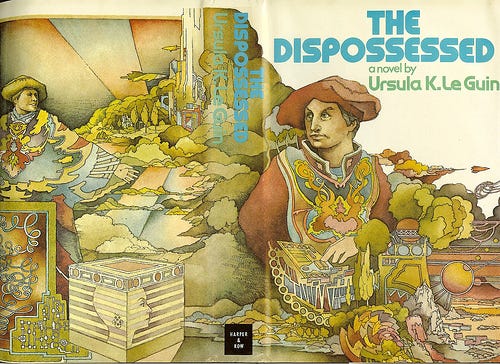
I started hostile. Urras seemed like a transparent critique of Earth, while Anarres seemed too good to be true. By the end, I realized I was right about Anarres and wrong about why: its failure to live up to its ideals is exactly Le Guin’s subject. It's not about the superiority of anarchy to capitalism, but the way power survives every attempt to abolish it and how a society's ideals dilute over generations. Faced with the failures of Urrasti capitalism, Thuvian communism, and Anarresti anarchism, Shevek gives his life's work away to the commons.
Power games are inescapable
Bedap calls the Production and Distribution Coordination (PDC) "an archistic bureaucracy." This exchange drives it home:
Shevek: “What are you talking about, Dap? We have no power structure.”
Bedap: “No? What makes Sabul so strong?” [...] “Public opinion! That’s the power structure he’s part of, and knows how to use.”
Sabul initially rejects Shevek's requests to publish his work in a local journal. But when Takver shrewdly suggests Shevek invite Sabul as a coauthor, Sabul agrees and proceeds to redact Shevek's work into a coauthored package, taking credit for work that wasn't his. Sabul’s power resembles C. S. Lewis’s Inner Ring: he controls access and recognition, while others' fear of exclusion makes that informal authority effective.
The episode reminded me of graduate school. I was first author on a paper rejected from CHI. My advisor then took the same work, repackaged it, resubmitted it with himself as first author, and got it accepted to UIST. The maneuver worked: the paper was published, and I benefited from remaining a coauthor. What soured me was not simply losing first authorship but understanding the system’s incentives. That experience encouraged me to return to industry sooner, without pursuing a PhD.
Anarchy and bureaucracy are not opposites. Anarres can be highly bureaucratic without formally ceasing to be anarchist. On Anarres, no hierarchy is supposed to exist, so nobody possesses an acknowledged right to command. But its hostile environment makes coordination unavoidable. Anything scarce must be allocated, and whoever controls its allocation acquires power, whether or not the society calls it that.
Even Anarresti names encode this paradox. Abolishing inherited surnames and honorifics eliminates markers of lineage and rank, but assigning every citizen a unique name requires centralized administration. Anarres has abolished many forms of hierarchy, but not the machinery of coordination in which hierarchy can reappear.
When a society denies that power exists, informal power becomes illegible and unaccountable. It concentrates in shadow hierarchies whose authority is obscured by the society’s own language games.
| Formal power | Shadow power | |
|---|---|---|
| Archy | A-Io: courts, contracts, property, rank, and openly exercised state power | Thu: party discipline, surveillance, and concealed coercion |
| Anarchy | Odo’s design: delegated, rotating, recallable coordination | Mature Anarres: reputation, conformity, and informal gatekeeping |
Freedom must be taught again and again
On a world with no jails and no word for jail, four boys transform a closet into a prison. They rig a door and a lock, and shut one of their friends inside for thirty hours to see what it feels like. Bedap explains it in a monologue:
...the will to dominance is as central in human beings as the impulse to mutual aid is, and has to be trained in each individual, in each new generation. Nobody’s born an Odonian [anarchist] any more than he’s born civilized! But we’ve forgotten that. We don’t educate for freedom. Education, the most important activity of the social organism, has become rigid, moralistic, authoritarian.
The original settlers did not merely believe in permanent revolution, they made one. Later generations inherit many of their institutions without having made the choices that made these institutions work.
Every idea or institution requires not just creation, but active maintenance. And this is often the harder, less glamorous part.
Three societies, three forms of control
Le Guin makes no attempt to hide her disdain for the splendor and inequality of the Ioti. And although Thu is not critiqued in depth, the many dysfunctions of the Soviet Union are readily transposed onto the Thuvian communist bureaucracy. In the familiar Urran Cold War, the belligerents fight proxy wars over resources while indulging the same jingoistic patriotism.
Le Guin comes closest to endorsing Anarres, but with heavy caveats. At bottom, she has strong critiques of all of the societies she's invented. For the Urrasti, Anarres is just a mining outpost, so even Anarres’s material independence is ambiguous, exporting minerals to Urras in return for goods it cannot produce itself.
Economics aside, Anarres is also the source of a lot of outlandish anti-Urrasti propaganda. Bedap realizes that they are being lied to, and the unfortunate answer to "who's lying to us?" in an egalitarian anarchist society is "ourselves." A century and a half into the Anarresti experiment, freedom has ceased to be the galvanizing force it used to be. It has become a premise that citizens are discouraged from questioning.
A-Io controls through property and status; Thu through the state; Anarres through conformity and informal exclusion. Le Guin does not treat these systems as equivalent, but none escapes the problem of power.
Giving the work away
When Shevek has a conversation with the Terran ambassador Keng, he names what he dislikes about the hypercapitalist Ioti: "You cannot say good morning without knowing your relative status." To the Ioti, other people are merely trainable organisms, not autonomous individuals.
Keng imagines that the ansible will unite the worlds. At last, humanity will be able to talk across interstellar distances. But Shevek dispels her optimism: “And what will you say?” Instantaneous communication abolishes delay, not domination, prejudice, or stupidity. Same human shit, transmitted faster.
Shevek knows that his work on Simultaneity is important, yet he experiences its creation not as an assertion of ego but as an act of surrender. I am reminded of Bach's devotional posture toward composition, beginning his works with “Jesus, help” and ending with “glory to God alone.” (See The best work can feel like something working through you)
The false starts and futility of these past years proved themselves to be groundwork, foundations laid in the dark but well laid. On these, methodically and carefully but with a deftness and certainty that seemed nothing of his own but a knowledge working through him, using him as its vehicle, he built up the beautiful steadfast structure of the Principles of Simultaneity.
When Shevek views himself as a medium channeling a discovery, discovery becomes less an achievement to possess than a gift passing through him. Shevek wants his relationships and his work to increase what is available to everyone, rather than improve his position relative to others.
Neither world reliably permits this. Urras wants to own his work and Anarres lets Sabul control its circulation. Capital captures it as property, while bureaucracy captures it through gatekeeping. Shevek’s answer is to transmit the theory to every world, preventing either government from monopolizing it. This is what attracts me to open source: knowledge can escape its gatekeepers and become the starting point for work its creator could never have imagined.