The Crisis of Narration by Byung-Chul Han
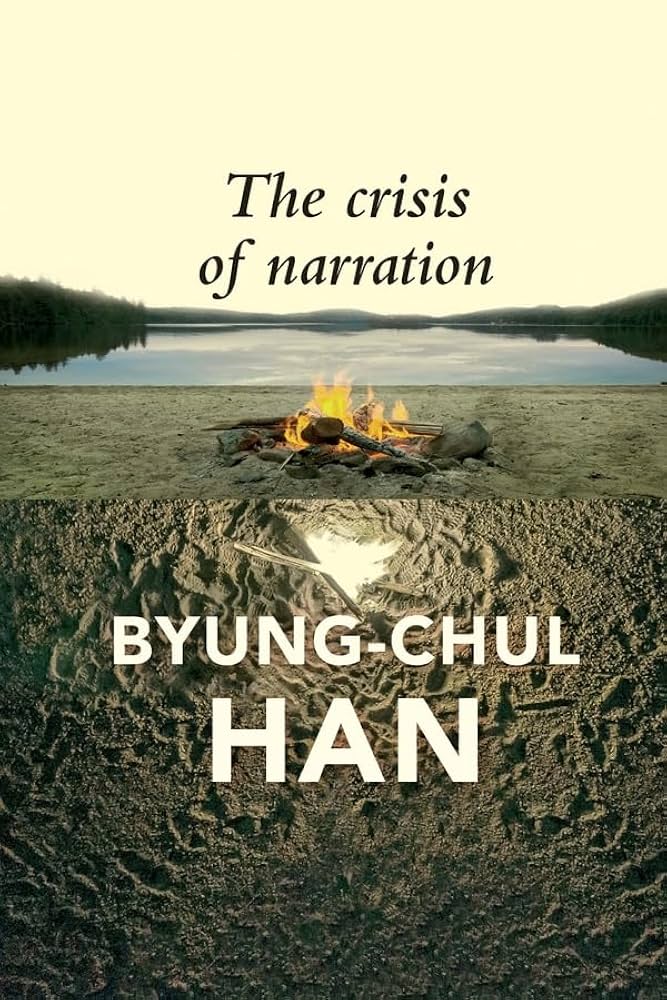
Han spends much of The Crisis of Narration mourning a lost world, one where humans were born into compelling, unifying narratives full of wisdom. Over time, this way of life shattered into many little narratives that fail to create the same level of overarching framework. Wisdom collapsed into knowledge, knowledge into information, and information into data. This is well captured in the Data Information Knowledge Wisdom (DIKW) pyramid, and by T. S. Eliot, who wrote:
Where is the Life we have lost in living?
Where is the wisdom we have lost in knowledge?
Where is the knowledge we have lost in information?
Three historical eras of narration
BCH splits our timeline into three parts:
- Pre-modernity: you lived inside a very clear narrative that you inherited by virtue of birth into a family, a culture, a society, a religious tradition.
- Modernity: a time of barbarian visionaries, where bold new stories were formed. He includes The Communist Manifesto as an example and cites "Glass Architecture", an ode to glass which was meant to be the medium of the future.
- Late modernity: the time in which we find ourselves lacks the imagination and boldness for interesting stories. All of our stories have been subsumed by capitalism.
He cites a well-known Hasidic parable to illustrate this generational decay:
When the Baal Shem had a difficult task before him, he would go to a certain place in the woods, light a fire and meditate in prayer – and what he had set out to perform was done. When a generation later the ‘Maggid’ of Meseritz was faced with the same task he would go to the same place in the woods and say: We can no longer light the fire, but we can still speak the prayers – and what he wanted done became reality. Again a generation later Rabbi Moshe Leib of Sassov had to perform this task. And he too went into the woods and said: We can no longer light a fire, nor do we know the secret meditations belonging to the prayer, but we do know the place in the woods to which it all belongs – and that must be sufficient; and sufficient it was. But when another generation had passed and Rabbi Israel of Rishin was called upon to perform the task, he sat down on his golden chair in his castle and said: We cannot light the fire, we cannot speak the prayers, we do not know the place, but we can tell the story of how it was done. And, the story-teller adds, the story which he told had the same effect as the actions of the other three.
Han's gloss on the parable is characteristically bleak:
The world becomes increasingly disenchanted. The mythical fire has long since burnt itself out. We no longer know how to say prayers. We are not able to engage in secret meditation. The mythical place in the woods has also been forgotten. Today, we must add to this list: we are losing the capacity to tell the story through which we can invoke this mythical past.
This seems like the most pessimistic interpretation possible. The Baal Shem Tov story can be seen far more optimistically: despite all the changes, we still have stories. And even though it is harder to tell them, we can still put in the effort and make it happen. Besides, we are now free to find our own stories, and isn't that better than just being stuck with the one you happened to have been born into?
Narration vs. information
Narration cannot be easily created from information, and throughout the book BCH sprinkles this idea in a haphazard way. Quoting variously:
- Self-Knowledge through Numbers’ is an illusion. Self-knowledge can be generated only through narration
- Big data merely discloses correlations between things. Correlations are the most primitive form of knowledge.
- De-narrativized memories resemble junk-shops – great dumps of images of all kinds and origins, used and shop-soiled symbols.
- Heaps of data or information are storyless. They are not narrative but cumulative.
- The manic pursuit of health and the optimization of life can occur only in a naked and meaningless world. A narrative, by contrast, cannot be optimized, because it has intrinsic value.
- In the end, ['Stories' on social media] are information adorned with images – information that is briefly registered and then disappears. The stories do not narrate; they advertise. Vying for attention does not create community.
Good storytelling must refuse to explain itself
Withheld information – that is, a lack of explanation – heightens narrative tension.
If a story explains itself too easily, there is nothing to discuss. If it is slightly mercurial and mysterious, it can easily survive for thousands of years. Every generation, every reader finds something different in it. Explanation would kill this generativity. Benjamin uses the example of the story of Psammenitus:
When the Egyptian king was captured following his defeat at the hands of the Persian king Cambyses, Cambyses humbled his prisoner by forcing him to watch the triumphal procession of the Persians. He arranged it that the prisoner should see his captured daughter pass by as a maid. While all the Egyptians standing along the way were lamenting this fact, Psammenitus stood silent and motionless, his eyes fixed on the ground. When he saw his son, who was being led to his execution as part of the procession, he was still motionless. But when he recognized his servant, an old and frail man, among the prisoners, he hit his head with his fists and expressed his deep mourning. For Benjamin, this story reveals what true storytelling is. He believes that any attempt to explain why the Egyptian king began to lament only when he saw his servant would destroy the narrative tension.
Storytelling as a miracle cure
I found BCH's general attitude towards storytelling to be somewhat endearing. Usually he is a total downer, but here at least he makes good points and really endorses storytelling as a practice:
- Narrating requires leisure. Under conditions of accelerated communication, we do not have the time, or even the patience, to tell stories. We merely exchange information.
- Storytelling requires a state of relaxation. For Benjamin, the ‘apogee of mental relaxation’ is boredom. It is the ‘dream bird that hatches the egg of experience’.
- Telling stories is healing because it creates deep relaxation and primordial trust. The loving voice of the mother soothes the child, strokes the child’s soul, strengthens their bond, supports the child.
- The hand that touches has the same healing powers as the voice that narrates. It creates closeness and trust. It releases tension and removes fear.
This is the third BCH pamphlet I've tackled. I do like his ideas, but they feel derivative. (Is this a summary of a summary? Likely, yes.) BCH's most insightful points derive from Walter Benjamin's essays. These include "The Storyteller" and "Experience and Poverty", which I plan to read soon.