Defying Financial Gravity
When a bridge collapses, blaming gravity is a non-answer. Engineers are supposed to design for gravity, and people who design companies should similarly design for financial gravity. This book is about how to do that.
Eric Ries, author of "The Lean Startup", spent most of his career advising early stage startups, but unlike most of the rest of the venture class, he seems to have become disillusioned with the enterprise. Startups are inherently short-termist, and corporations in general tend to start great and degrade over time, straying from their original mission as more and more of the corporation's efforts go towards appeasing shareholders.
As a systems thinker and builder, Ries naturally wanted to fix the problem he identified. The result was the LTSE, a new stock exchange that would focus on the long term by changing various incentives for listed companies. But this is a heavy lift: you cannot simply change the system by willing a new one into existence.
A reasonable parallel question then is: how can you build a company in the existing system, warts and all, without having it fall prey to the same known failure modes. This is what Incorruptible attempts to answer.
Ries's own journey from Big VC enthusiast to a reformer feels like a bit of an apology circuit. It's like LTSE and Incorruptible are attempts at giving back to the community as a sort of indulgence. But I understand. I feel a similar microcosm of self-imposed pressure after 15 years at Big Tech.
Incorruptible is full of practical tips for a founder to structure their already-viable business in a way that is suited to the long term, able to resist the pressures of the market.
I often paused to reflect: why am I reading the book given that I am not a founder and have never built a viable business? I have a few provisional answers. Firstly, in the spirit of the temporarily embarrassed millionaire, I'm not a founder... YET. Secondly, ideas in this book can equally apply to help identify whether a company you'd be joining is value aligned. And lastly, corporate governance is more interesting than I expected, just as a matter of academic curiosity.
Ries skips the hardest step: how to actually define and create a company ethos worth protecting with a viable business model in the first place. But this feels too tacit to learn from a book.
Financial gravity pulls on every corporation
Like the engineer, whoever designs a company is designing against a constant gravitational load. The financial system exerts constant, predictable forces. Here's the pattern, echoing The Authoritarian High-Modernist Recipe for Failure. The outcome is a form of enshittification:
- A viable company has goodwill worth protecting.
- Ownership dilutes or careerism creeps in, with shareholder primacy dragging resources away from users.
- The "best practice" playbook via outside consultancy liquidates the sources of goodwill (quality, wages, R&D) and converts goodwill into near-term profit.
- Reputation drains slower than the cash arrives, so the P&L looks really good while the actual damage is invisible.
- Over time, the reservoir empties; deferred damage lands all at once.
Attempts at systemic reform (e.g. Long-Term Stock Exchange) have not solved all known problems. No surprise there; after all, nobody's invented an anti-gravity device either. The LTSE tries to weaken financial gravity at the systemic level but Incorruptible takes the more practical approach: designing companies to withstand the load.
There's a whole graveyard of companies ruined by financial gravity, but many examples come from following "best practices" from seasoned board members and hired professional CEOs. Consider Boeing under the James McNerney transition. As Boeing's first CEO without a deep background in aviation, he followed the usual CEO playbook: outsource engineering, optimize margin, financialize. The result was disastrous for Boeing, and Yale management professor Gautam Mukunda called McNerney "arguably the worst CEO in American history".
Hixie describes the culture at Google as shifting from what's "best for the user" to what's "best for Google" to what's "best for the decision-maker". I had front-row seats to that movie, and "Don't be evil" was scrubbed from Google's Code of Conduct by 2018.
Ries argues that often there's nobody to blame for the decline of a company; neither the founder, nor the professional CEO, nor the conservative board member. Nobody but the resulting superorganism. "The bank is something more than men, I tell you. It's the monster. Men made it, but they can't control it." — Steinbeck
But this blamelessness smells a bit fishy to me. Remember financial gravity? If an individual owns 61% of the voting shares of a company, then shouldn't he be able to build a better bridge? More on this later.
Redrawing the fiduciary boundary
I found it annoying that Eric Ries was trying to redefine what "profit" means. But I found a way that sits better with me. If you pick a narrow boundary for your circle of concern (e.g. shareholders), you can do a ton of things that are terrible for users and employees and make the shareholders short-term happy. Here's my synthesis in a diagram:
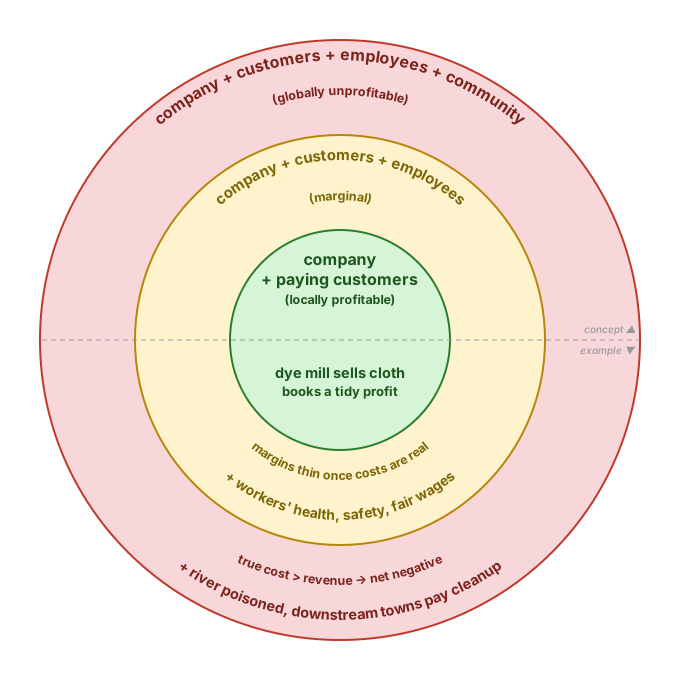
If you define profit broadly, net social value can flip sign as the boundary expands. Internalizing externalities, redrawing the accounting boundary so the actor bears the full cost, you end up with a very different situation.
Just as companies are often blind to negative externalities, they are also blind to positive externalities. In the diagram above, a dye mill is blind to the decline of the health of their workers, and the deleterious effects on the river. Conversely, take Sol Price. The tight circle around Price Club ultimately failed, but widen it one ring and the sign flips. Price invented the warehouse-club model and then shared it with his protégé Sinegal who created Costco.
All externalities are difficult for corporations to internalize, but companies can extend their positive impact beyond their own walls and into the ecosystem. Many of Ries's examples illustrate how high standards can percolate through the entire supply chain:
- Costco's food safety > FDA since it inspects more facilities than the FDA and holds suppliers to a higher standard than federal law.
- After a scandal, Patagonia set a forced labor floor on its suppliers, ensuring that migrant workers cannot be trapped by recruitment-debt bondage among their Taiwanese suppliers. Similarly Tony's chocolate fights forced child labor in the cocoa industry. Started by Dutch journalists angry about this issue, their awareness writing went nowhere. They tried another approach and their ethically-sourced test batch sold out instantly, so they built a business on strict supplier requirements.
- Volvo's seatbelt patent, given away. Invented the three-point belt (1959) and released the patent rather than enforce it, judging lives saved > licensing revenue. It became an informal industry best practice, then a US national highway standard.
- The Walmart effect vs. the Costco effect. A Walmart supercenter opening measurably drains its town: grocery wages down, aggregate local income down over time. The Costco effect is the opposite: the same act of "big-box store arrives" runs the externality the other way.
Mission lock: history and a contemporary revival?
So why do some companies radiate benefits while others drain their towns? It comes down to who they answer to.
Most companies are owned by institutions and the public, meaning there really is no specific person to blame. But it wasn't always the default. Before general incorporation spread in the late 1800s, a company needed a special charter from the legislature to exist at all, granted for a specific public purpose it was legally bound to pursue. The charter was a mission lock. General corporations for "any lawful purpose" made mission optional; Ries's SHC rebuilds that leash with private law.
Concentration fixes one thing diffusion breaks: accountability. If a founder holds 61% of the votes, "blame the superorganism" stops working; there's a driver at the wheel, and someone to blame. What you don't have is any guarantee that he's worth trusting.
One solution to this is to lean back into employee ownership. At the very least, employee ownership can help align the company with their needs and the needs of the users. Sears in 1968 looked like this. Employees held a controlling-sized bloc through a profit-sharing trust, but it operated as a retirement fund, didn't steer the company, and Sears died anyway. Today, Big Tech pays lavish equity but employees control a small fraction of the company because they tend to sell as they vest and no trust holds the shares.
| Voting power | Sears (1968) | Apple | Meta |
|---|---|---|---|
| Employees | 30% | <1% | <1% |
| Founders | 5% | <1% | 61% |
| Institutions & public | 65% | 99% | 39% |
So you're stuck between two bad options: either concentrate control and you're betting on a founder's virtue, or distribute control and you're back to nobody-in-charge. Ries proposes a third path: don't rely on who holds the wheel, lock the wheel to the mission again.
Defying Financial Gravity: checks and balances with teeth
Financial gravity pushes companies into shareholder primacy, but there are alternatives! Building a company around a mission is in many ways much harder than the default path but there are ways in which it is easier:
- Lower alignment cost: self-selection filters in people who already share the same goal.
- Faster decisions: a clear north star prunes the option space.
- Recruiting/retention: mission attracts talent that money alone wouldn't and gives it a reason to stay.
- Trust: Not extracting maximally builds durable equity.
Though Ries never frames it this way, many of the corporate governance ideas in his book remind me of checks and balances in the government. It's a little like the Magna Carta or the US Constitution, but applied to firms. I like how his remedies are grounded in corporate charters from the 19th century, not greenfield solutions.
A key thing about checks and balances is that they need teeth. And I think Ries praises some institutions which lack enforceability and instead introduce new problems. I balked at the idea of a Department of Corporate Purpose, ESG, Chief Purpose Officer. The idea of two-sided review just sounds like invasive monitoring unless the culture of the company is already super bottom-up.
The heart of Ries's book is the Spiritual Holding Company (SHC), whose goal is to split the two things a company usually fuses: the profit engine and the mission. Ries advocates for putting them into separate entities so that the profit engine can be beholden to the mission.
A corporation is by default a despotic monarchy. The SHC makes it more like a constitutional republic: mission as the inalienable-rights layer, the trust as the branch that can't be captured by capital.
Ries spends much ink on how specifically to structure a constellation of companies to make an incorruptible mission lock. A separate spiritual holding company seems reasonable, but some of the examples of a multi-corporate interlocking structure seem overly complex for a fledgling company. How much to lean into his "it's always too early until it's too late" advice remains an open question.
Examples of the SHC pattern in practice:
- Anthropic Long Term Benefit Trust (LTBT) is a Delaware purpose trust. Five trustees can appoint and remove the board. Their power grows as Anthropic grows, eventually assigning all board seats.
- Triggered by Chouinard landing on the Forbes billionaire list, the founder of Patagonia reacted by shedding the net worth of the company into the holding company. Patagonia also added an extra layer: a protector who checks the holding board itself for corruption.
- The Novo Nordisk Foundation controls the drug company. Societal health gain (Ozempic) that dwarfs captured revenue. The foundation structure dates to 1989 with roots to the 1920s insulin-era Novo/Nordisk entities.
Costco is not controlled by a SHC but has a lot of different charter lockouts. This has given Costco amazing stability and it remains excellent after almost half a century. But it is vulnerable. What happens when the Sinegal → Jelinek → Vachris chain is interrupted by a James McNerney?
Novo Nordisk is definitely a lindy example of this model working well, but only time can tell whether Anthropic is a long term success and whether its governance structure can hold against financial gravity.
Put user trust first and beware value capture
Governance can lock the company to the mission, but the day-to-day still runs on numbers, and as The Score by C. Thi Nguyen illustrates, it's really easy to get this wrong. Ries calls it surrogation, but I prefer Nguyen's framing: Value capture and collapse involves complex values being simplified and replaced by institutional metrics.
According to pollsters in the 1950s, 35% of Americans were dissatisfied with customer support. Companies responded by introducing new metrics. Customer support reps were told to minimize metrics like "average time per conversation" thinking that shorter calls would mean more effective resolution of issues. But of course customer service reps would just hang up mid-call. By the 70s, American dissatisfaction with customer support doubled.
Wells Fargo had a famous "eight is great" policy (8 products per customer). The result was ~3.5M accounts opened without customers' consent, resulting in disaster for users and ultimately Wells Fargo itself.
New York state and Pennsylvania publish cardiac-surgery report cards which measured per-surgeon mortality rates to make quality legible and reward the best. The result is that surgeons refuse the sickest patients in order to boost their stat.
Ad-supported video platforms like TikTok and YouTube optimize for watch-time, chosen ostensibly as a proxy for value delivered to the user. But the best way to ramp that metric is to autoplay the next episode, feed users outrage-bait, and pull them deeper into the rabbit hole.
In contrast, Costco’s ~90% voluntary membership renewal rate is the gold standard. It works well for a few reasons. Members explicitly choose to re-up every year; there's no auto-renew. There's a costly fee associated with it, and you can walk at any point.
Ries suggests implementing a culture bank. If anyone does something that is aligned with the culture, that's a deposit to the bank. Anything misaligned is a withdrawal. This is very similar to Duolingo's idea of a trust battery, which seems much more specific to me. It's much easier to know if your actions will increase or decrease user trust than whether something you do is going to improve or hurt company culture.
One thing I'm still mulling: the sportswear company I actually reach for has no moral narrative at all. How ironic, given I just finished Moral Ambition by Rutger Bregman and its case for exactly the opposite. I find myself continually gravitating toward Arc'teryx over Patagonia. Patagonia has a pristine moral manifesto but when my Arc'teryx jacket failed a decade ago, they didn't send me a beautiful pamphlet on environmentalism but gave me $900 in credit. Now whether they would do it today is unclear, especially since in 2019, Chinese sportswear giant Anta Sports bought their parent company Amer and took it public in 2024. Whether they can withstand financial gravity without an SHC or any self-imposed Costco-like constraints remains to be seen.
A couple of personal reflections
Overall I really enjoyed Incorruptible. I'm inspired by spiritual holding companies and it's exciting to see Anthropic and others try to implement SHCs. Fingers crossed this experiment passes the test of time. Perhaps some of the corporate governance ideas in this book are part of the puzzle for reversing Enshittification? But it skips the prior and harder problem: deciding which ethos deserves preservation and building a product people genuinely want.
If I ever graduate from temporarily embarrassed founder to actual founder, I'm drawn to companies like Obsidian or Home Assistant which start small, don't attempt to hyperscale with VC money, provide a compelling product for free, put users first, and then become very profitable by selling infrastructural features.