Children of Time by Adrian Tchaikovsky
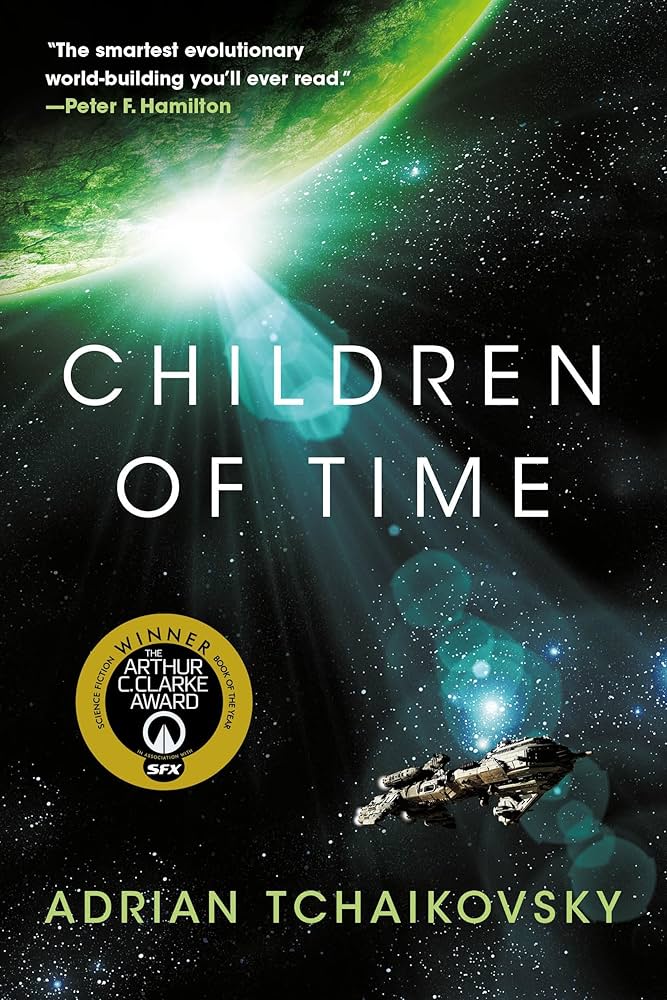
A compelling first contact story with many twists. Spiders, Ants, Monkeys, AI, Spaceships, Cryogenics, oh my! Tchaikovsky really crams a lot into this work. Definitely worth a read in and of itself, but also a good example of exploring ideas through fiction (see Power of Fiction). As usual, some of my highlights follow.
Dipping in and out of time
One key device in Children of Time are the cryogenic pods which have been perfected. Usually this is a one-and-done affair to take into account the long times involved in traveling interstellar distances. Fall asleep, travel for hundreds of years, wake up refreshed at your destination. Here, sleep pods enable the human protagonists to dip in and out of the timeline. Thus, the human story narrated by Mason the classicist features key crew like engineer Lain and commander Nguyen interacting with the Arcship Gilgamesh over generations.
Tchaikovsky's Cryogenics mechanic makes deep time feel personal. I found this to be a refreshingly different angle on the same sleep pods, and it made me wonder what the implications of just this technology might be on our world today. Frederik Pohl said a good SF story should predict not the automobile but the traffic jam. Tchaikovsky's cryogenics deliver: the interesting part isn't the sleep pods themselves, but what happens when a few crew members persist across generations while civilizations rise and fall around them. Imagine having an ancient Egyptian, a Roman, and a Babylonian still on deck.
The spiders don't have the same masterful control of cryogenic sleep, but they have some other tricks up their many sleeves. Instead of dipping in and out of time as individuals, they pass on knowledge to their offspring through a genetic system called "understandings". This is one of the superpowers granted by the Nanovirus that enables animals on Kern's world to speed-run evolution. Tchaikovsky emphasizes this by focusing not on named individuals but on named personas. Thus, Portia, Bianca, and Fabian are effectively reincarnated many times over the timeline, and the reader gets little vignettes of spider social dynamics as they vary with the complexity of spider technology.
Longevity vs. Knowledge Transfer: Rather than focusing on longevity, what if we greatly improved intergenerational knowledge transfer? In favor of rolloverability versus longevity.
The space spiders are cool
Tchaikovsky uses spider biology as a defamiliarization engine. Grounding alien social dynamics in real arachnid behavior, he makes human contingencies visible. It made me curious enough to want to learn more about spiders.
Speed running evolutionary intelligence. Thanks to the Nanovirus, spiders became sentient and proceeded to speed run down an evolutionary path similar to humanity. Like humans, they had their own invention of projectiles, which were extremely effective. They had their own David and Goliath moment, where a clever little Portia spider emerged as the victor. They had their own bubonic plague and an unenlightened Middle Ages. This is a fun mechanic which gives Tchaikovsky an excuse to sneakily explain parts of human evolutionary history he was most interested in.
Spider Sex, Slavery, and Suffrage. In addition to technological progress, spider sexual relations are a window into their cultural evolution. After spider copulation, the female often consumes the male, and this instinct is deeply ingrained in spiders from birth. The male variety of spider is physically inferior, and subservient in every way. Matriarchal spider society mirrors an amped patriarchal human history, with males as "useless engines of reproduction". This is another clever technique to explore the contingency of male dominance over females.
Fabian the male revolutionary acts as primary emancipator for his sex. He trades his genius discoveries for more equality with the females. This narrative is an interesting blend of our own abolition and suffrage movements. It's a bit heavy-handed, but useful to illustrate arbitrariness by swapping genders onto different species, and well crafted with solidly researched facts about spiders.
Spider communication relies on vibrations sent across spiderwebs. This is functionally analogous to human speech, just in a different medium. I kept waiting for Tchaikovsky to lean on some interesting implications of this. For example, a spider could have cut strands from the web to control information flow to some spiders to prevent eavesdropping, but this wasn't something that he explored.
Spider anatomy. Tchaikovsky's spiders needed to solve the oxygen diffusion problem to scale up from 5-10mm—the kind of detail that signals he's done his homework. Fascinatingly, many simple animals lack diaphragms; they passively exchange air rather than actively pushing it.
The ending cannot hold: scenario planning
As the final battle came closer, I enumerated some scenarios for what might happen. Incidentally, this is a fun reader exercise, especially since you likely end up with clear resolution by the end of the book and can easily see how you did. A few possibilities in the conflict to come:
- Humans defeat spiders, colonize planet
- Spiders win, carry on intelligence
- Peaceful coexistence
- Human-spider symbiosis
I predicted coexistence, armed with the knowledge this book is part of a series. A universe without space humans and space spiders would not be that interesting. But how would that happen? I imagined two possibilities:
- Spiders keep frozen human fetuses alive, teach them spider ways
- Spiders figure out how to pass understandings to humans
In the actual ending, spiders contaminate humans with a limited version of the Nanovirus, containing an understanding that spiders are their proverbial children. This virus also removed the natural disgust humans have of spiders more generally.
I'd have preferred my first outcome, just because it felt more logically coherent. I thought the Nanovirus was all about passing down understandings from one generation to the next, but here the wise and omnipotent spiders have surprisingly created a completely different virus, transmitted through inhalation. Both the technology and method of transmission felt bolted on, having hardly been alluded to earlier in the book.